
Home » Testosterone Replacement Therapy DR Phillips » Comprehensive Men’s Hormone Panel in Orlando | Svelte Medical Weight Loss – DR Phillips
Comprehensive Men's Hormone Panel in Orlando | Svelte Medical Weight Loss - DR Phillips
The Total Number is Only Part of the Picture
Almost every week in Orlando, I receive a man who comes into our practice with a single lab drawn from his primary care physician stating that his total testosterone level is 450 ng/dL. The doctor says he is “normal” and he is feeling miserable. Fatigued by 2 p.m. in the afternoon, putting on weight, and not feeling any type of drive at work or sexual drive with his wife or girlfriend. What is happening to this man?
That one number tells you so little.
The total testosterone is simply just the tip of the iceberg. A large percent of your testosterone is bound to a protein called the Sex Hormone Binding Globulin, or SHBG, so even though your Total Testosterone is “normal,” your “free” testosterone is very low because so much testosterone is bound to the binding protein and is not able to be utilized by your tissues and organs. We get these cases almost weekly from men around Lake Nona to College Park. The number is great; the man feels terrible.
The men’s hormone panel measures several other markers which influence and work in concert with total testosterone: Free testosterone, SHBG to determine your bioavailable levels; Estradiol which is a key hormone in men to determine fat storage, depression and energy levels; DHEA-S which is a hormone which comes from the adrenals; and Thyroid function to rule out a hypothyroidism which can manifest as low testosterone.
And this is not guesswork. The Endocrine Society states that diagnosing testosterone deficiency with just total testosterone leads to missed hormone deficiency diagnoses and treatment for those who do not need treatment. We have watched and studied this for over 18 years as we work out here in Orlando and all throughout Central Florida.
Your hormones and metabolism are a system. Your insulin level determines your fat storage. Your cortisol level affects your sleep and stress level. Your estrogen levels affect your fat distribution and mood, not your total testosterone levels alone.
The point of the hormone panel is that all these hormones are linked to one another. If you pull one thread, the others move. If you have a man come to you complaining about being tired all the time, then why just check total testosterone? It’s not enough to check one lab value. Check all the markers so you can get a full understanding of what’s going on.
Are your previous labs enough for you?
This is a common question we ask every man who comes in to our clinic here in Orlando. Most of them have been told at least once that their lab values are “normal.” But normal on paper and optimal for men’s vitality and hormone restoration are two very different things.

How to Determine If a Full Hormone Panel Is Right For You
Maybe you’ve tried everything. You’ve cleaned up your eating, you are sleeping better, and you’re starting to exercise once again, but you just feel “off.” Again, we hear this from men everyday as they come walking into our Orlando clinic.
The Total Testosterone is just a piece of the puzzle. Think of it like checking your car’s oil but skipping checks for the transmission, coolant, or brakes. The only way to uncover the root cause of your problems is a complete picture, which is why a men’s hormone panel is so important.
The Indicators of a Real Hormonal Problem
Not every man who feels fatigued requires a hormone panel. However, certain patterns consistently occur that are nearly impossible to ignore once you know to look for them:
- Sustained exhaustion that isn’t relieved with rest or caffeine
- Increase in stubborn belly fat that doesn’t go away no matter how hard you try
- Apathy or mental fuzziness making your job seem twice as difficult
- Changes in your mood that your spouse or children notice before you do
- Loss of muscle mass even though you are working out on a regular basis
If you mention more than two or three of the symptoms to a patient we see, there’s a measurable problem. It’s not a personality issue. It’s not old age. It’s a metabolic problem that is identifiable and treatable.
Here is what surprises most men in the vicinity of Dr. Phillips and the rest of Orlando: the symptoms mentioned earlier are usually tied to insulin control, not testosterone levels. If your metabolism is stuck in a cycle of glucose oxidation, it has an adverse effect on your downstream hormones. Cortisol levels go up, free testosterone goes down, and DHEA levels plummet. None of this will be visible without a specific blood test.
When is a hormone panel a good idea? If you are over age 35 and have gained weight for no reason. If you are in your 40s or 50s and begin to feel sluggish by 2 p.m. Any younger man who has encountered a performance plateau with no explanation, no matter how hard he has worked. Each and every result will be personally reviewed by our board-certified physician, because numbers without context won’t make any sense at all.
Are these signs of a problem in your case? Call us and we’ll chat about it.

Preparing for your blood draw: Timing and Fasting are Important
This is something that many guys mess up more than you may be expecting. Even if we order the most hormone panel available, your results will mean nothing if you eat a pile of pancakes two hours before you have your blood drawn. It really does add up with a small amount of preparation.
You’re required to fast prior to the blood draw, and you will be instructed to not eat or drink anything containing calories for 8 to 12 hours before that. Drinking water is not only allowed but recommended. Coffee with cream, juice, or even a protein bar you brought with you to eat on the drive to your blood draw? These can cause insulin to spike and the glucose values to change, thereby clouding our understanding of your results. Your testosterone levels have an equally strong dependence on food that you just consumed. We see this almost every week; a man eats breakfast out of habit, and then we have to reschedule.
Morning draws offer the most accurate data
Testosterone levels fluctuate in a daily pattern. In the morning, it’s at its highest and then progressively declines throughout the day. If a man in Orlando is experiencing sluggishness or low libido, having a morning level allows us to determine if his body is capable of producing sufficient levels during.
A late afternoon draw at 3 p.m. may yield low numbers that appear alarming but are typical for this time of day. Hence, we conduct the vast majority of our hormone panels before 10 a.m.
So, here are a few things to remember the night before and morning of:
- Cut off food at 9 or 10 p.m. the night before
- Hydrate. This will help with vein access
- Avoid your morning brew with cream or sugar
- Take normal meds
- Be early. Give yourself time to relax before going in.
Traffic and cortisol can mess with your results too, so drive in without a time crunch whether you are coming from Lake Nona or the other side of town. Our ideal scenario for a panel is an early, fasted, low-stress morning draw.
We talk through this when you set up the booking, and it’s really nothing: no food, just water, and be on time. With over 18 years in Central Florida, a physician who is board-certified, a thorough lab review for every panel, and an emphasis on accuracy, we won’t miss a thing due to avoidable delays.
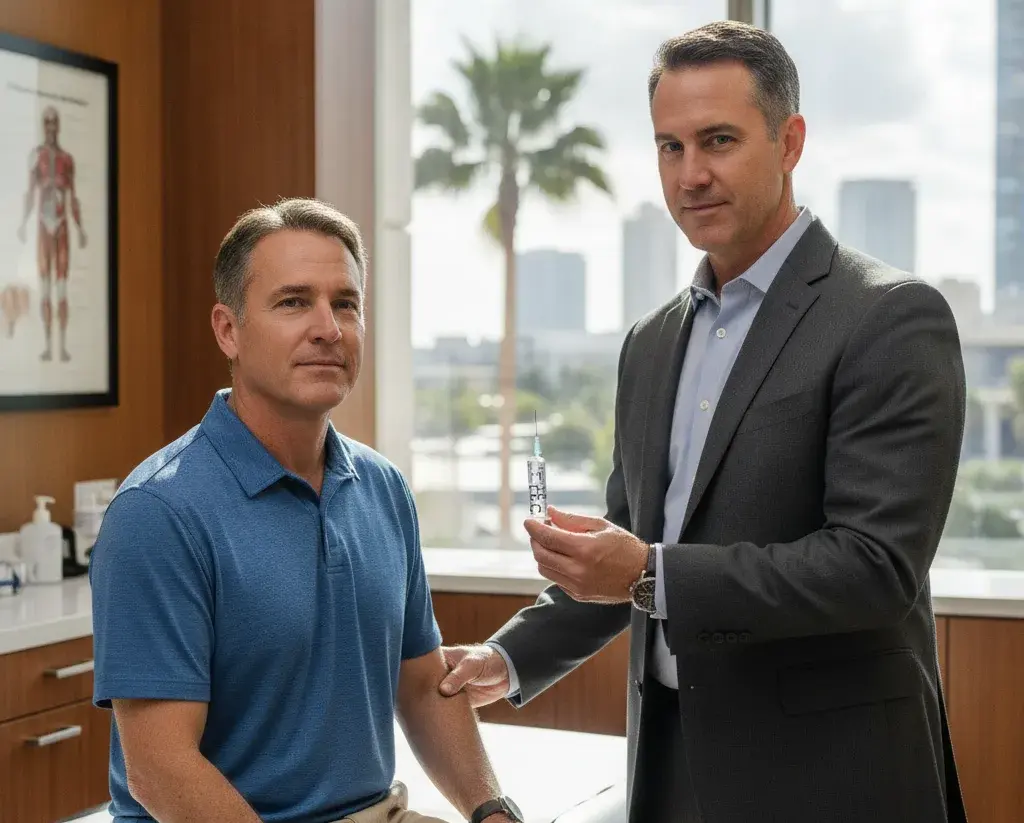
What Happens During Your Hormone Panel in Orlando
Most guys who come to our office in Orlando are at least a little intimidated. That’s understandable. But this is what we tell every patient: the hardest part is finding a parking space. It’s otherwise very routine.
It starts with a blood draw. Instead of guessing what’s happening to your internal chemistry, we can measure it. exactly what your hormone numbers are, not what you think they are based on your symptoms and at 2 a.m. on Google.
What Are They Testing For?
A hormone panel is much more than one single test of testosterone. It’s a broad approach to your hormonal health. Here are the things we look at:
- Total and free testosterone to measure both what your body is producing and what’s available for your body to use.
- Estradiol (E2) because in men, estrogen issues contribute to issues with fatigue, weight gain, and mood swings.
- DHEA-S which is a marker of your adrenal function and hormonal reserve.
- Thyroid markers: TSH, free T3 and free T4 because a sluggish thyroid can cause a host of very similar symptoms to low testosterone.
- Fasting insulin and glucose to measure your metabolic health and insulin stability.
We deal with these issues every single week. A guy will come to the clinic convinced his testosterone is at an all-time low. His hormone panel shows his T is okay, but his insulin levels are astronomical. That changes the conversation completely. The patient is stuck in a glucose-burning mode, storing fat, and spiking and crashing sugar all day. Without the full hormone panel we’d totally miss it.
It only takes about ten minutes for the blood draw.
We move fast on labs, most coming back in a couple of days, and our board certified physician takes a close look at each and every panel himself. No nurse practitioners guessing, no computer algorithms spitting out a form letter. When we have the results you sit with us and go over each and every marker, explaining to you what’s elevated, what’s suppressed, what’s driving the symptoms you feel. We hear this from men all over from the Thornton Park area to elsewhere in Orlando, it’s the first time they’ve really gone through their labs with a doctor like this. It changes how you see yourself. So you leave our offices that afternoon with some real answers.
Reviewing your lab results with a real clinician. We see the same scenario a few times a week. Someone walks in holding a lab sheet from another clinic, total testosterone looks good at 450 ng/dL so “he’s fine” or something along those lines. And the patient is tired every day by 2 or 3 p.m., body fat keeps creeping up, and his mental state is off. That lab value alone isn’t the whole picture of what’s going on, it never is. It takes the full panel we order in men’s hormone replacement therapy to get a complete read on the hormonal milieu. Sitting down with a board certified physician to go through all of it can change a guy’s life.
Our Orlando clinic has been around for almost two decades, and in all of those years we have never had to tell someone, “I don’t know exactly what is going on with your labs.” When you come in for a results review, you won’t just be handed the lab sheet, you will sit down and go through it with a real clinician. We’ll take a look at how the different hormones work in your body, for example, total testosterone is fine but your free testosterone is low. Maybe a high SHBG level is soaking up the testosterone you’re putting out, and your estradiol is high enough to cause fatigue and weight gain. Those interactions matter a great deal more than any one number does. Some men are also unknowingly exposed to workplace or environmental factors that disrupt normal hormone function, which is why we sometimes point patients to OSHA guidance on hormone-related reproductive hazard recognition when occupational exposure seems like it could be part of the picture.
What we go over with you:
- How your free and total testosterone levels stack up for your age and your goals.
- Whether SHBG or estradiol levels that run high are messing with those testosterone results.
- Your thyroid values and how they could be affecting energy, metabolic rate, and the fat you store.
- Insulin and other metabolic markers indicating that your body has been trapped in a cycle of metabolizing glucose.
- Your DHEA-S and cortisol values, which can say a lot about your stress and your ability to recover.
One of those things we look at in your labs is insulin. So many men in Lake Nona and throughout the Orlando metro area try diet after diet and keep gaining weight. We show them that insulin dysfunction is the culprit and they’re rebounding. And that’s why they have trouble with cravings and body fat. So if you have lab results and you’re not sure if those levels are ok, send them to us. This is what our physician reads all the time. We’ll let you know exactly how those lab values stack up and make you understand if it would make sense for you to do something about those numbers. It won’t just be guesswork and a generic recommendation that we throw at you.

Book Your Consultation
Frequently Asked Questions
How do I prepare for a hormone panel blood draw in Orlando?
You need to fast for 8 to 12 hours before your appointment. Skip food, coffee with cream, juice, and protein bars, since these can spike insulin and skew your results. Water is fine and actually encouraged. We see men drive in from Lake Nona or Dr. Phillips grabbing a quick breakfast on the way, and it throws off the whole panel. A little planning the night before makes your results actually mean something.
My primary care doctor said my testosterone is normal. Why would I need more testing?
A single total testosterone number rarely tells the full story. Many Orlando men come to us with a “normal” reading of 450 ng/dL but still feel exhausted and foggy, because their free testosterone is low due to high SHBG binding. We check free testosterone, estradiol, DHEA-S, and thyroid function together, since these hormones move as a system, not in isolation.
What symptoms mean I should get a full hormone panel instead of a basic testosterone test?
Persistent fatigue, stubborn belly fat, mental fog, mood shifts your family notices, and muscle loss despite regular workouts are the patterns we watch for. If two or three of these sound familiar, there’s usually a measurable metabolic issue behind it. This shows up often in men over 35 in Orlando who assume it’s just aging or stress, when it’s actually identifiable and treatable.
How long does it take to get results after a men’s hormone panel in Orlando?
Most men get their full panel results back within a few business days of their blood draw. Every result is personally reviewed by our board-certified physician before we call you, because raw numbers without context don’t tell you much. We’ll walk through what each marker means for your specific symptoms, not just hand you a printout.
What hormones actually get tested in a comprehensive men’s panel?
A complete panel measures total and free testosterone, SHBG, estradiol, DHEA-S, and thyroid function. Each one influences the others, so checking only total testosterone is like checking your car’s oil but skipping the transmission and brakes. This full picture is what lets us tell Orlando men what’s actually driving their fatigue or weight gain, instead of guessing.
Do I need to worry about parking or getting to your Orlando clinic for my blood draw?
Parking is easy and close to our entrance, so you won’t lose time before your fasting appointment. We schedule most blood draws early in the day, which works well for men commuting from College Park or Dr. Phillips before work. Just remember to keep the fast going right up until your draw is finished.