
Home » My Doctor Said My Testosterone Was Normal, So Why Test Again?
My Doctor Said My Testosterone Was Normal, So Why Test Again?
A single normal result may not show the full picture, because testosterone peaks in the early morning, lab reference ranges are very wide, and many checkups only measure total testosterone. If you've been told your level is normal but you still don't feel right, those three gaps are where to start. A late-day blood draw can read differently from your true morning baseline. The American Urological Association guideline calls for two separate early-morning tests before low testosterone is confirmed. High SHBG, a protein that binds testosterone, can make total testosterone look normal while free testosterone, the usable portion, is low. If fatigue, low drive, or muscle loss continue, a fuller panel that adds free testosterone, thyroid, and metabolic markers can show what one number missed.
- Why Can a Normal Testosterone Result Still Miss the Problem?
- Does the Time of Day Matter for a Testosterone Test?
- What Is the Difference Between Total and Free Testosterone?
- What Can Lower Testosterone on the Day of Your Blood Draw?
- Which Other Hormones and Markers Should Be Checked With Testosterone?
- When Does Retesting Make Sense for Men in Lake Mary?
- How a Physician-Reviewed Hormone Panel Works at Svelte
- The Bottom Line on Retesting a Normal Testosterone Result
Why Can a Normal Testosterone Result Still Miss the Problem?
A normal result only means your number landed inside a very wide range. It doesn't prove the level is right for your body, and it doesn't explain why you feel the way you do.
The reference range for total testosterone covers a large spread of healthy men. The American Urological Association (AUA) uses about 300 ng/dL as a common cutoff for low testosterone. With that cutoff, a man at 310 ng/dL and a man at 900 ng/dL can both be told “normal,” even though their levels are far apart.
Lab ranges are built from population data, and some labs set their own ranges. The same number can be flagged at one lab and passed at another. That variation is one reason we don't treat a lab flag, or the absence of one, as a diagnosis. Low testosterone is confirmed by symptoms, repeat results, and a physician's review together.
| What the lab report says | What it may not show | What to ask next |
|---|---|---|
| Total testosterone “within range” | Whether the draw was done in the morning | “What time was my blood drawn?” |
| No flag on the result | How close you are to the low cutoff | “Where in the range did I land?” |
| One testosterone value | Free testosterone and SHBG | “Was free testosterone measured?” |
| Testosterone only | Thyroid or metabolic causes of symptoms | “Were thyroid and blood sugar checked?” |
What Does “Low Normal” Testosterone Mean?
“Low normal” means your result sits just above the cutoff, so it passes the lab check but lands near the bottom of the range. A low-normal number isn't a problem by itself. Paired with ongoing symptoms, though, a result near the line is a common reason doctors order a repeat morning test.
One borderline number isn't enough to start treatment, and it isn't enough to rule treatment out either. Testosterone readings move from day to day, so a pattern across two or more properly timed tests tells a physician much more than a single value.
Does the Time of Day Matter for a Testosterone Test?
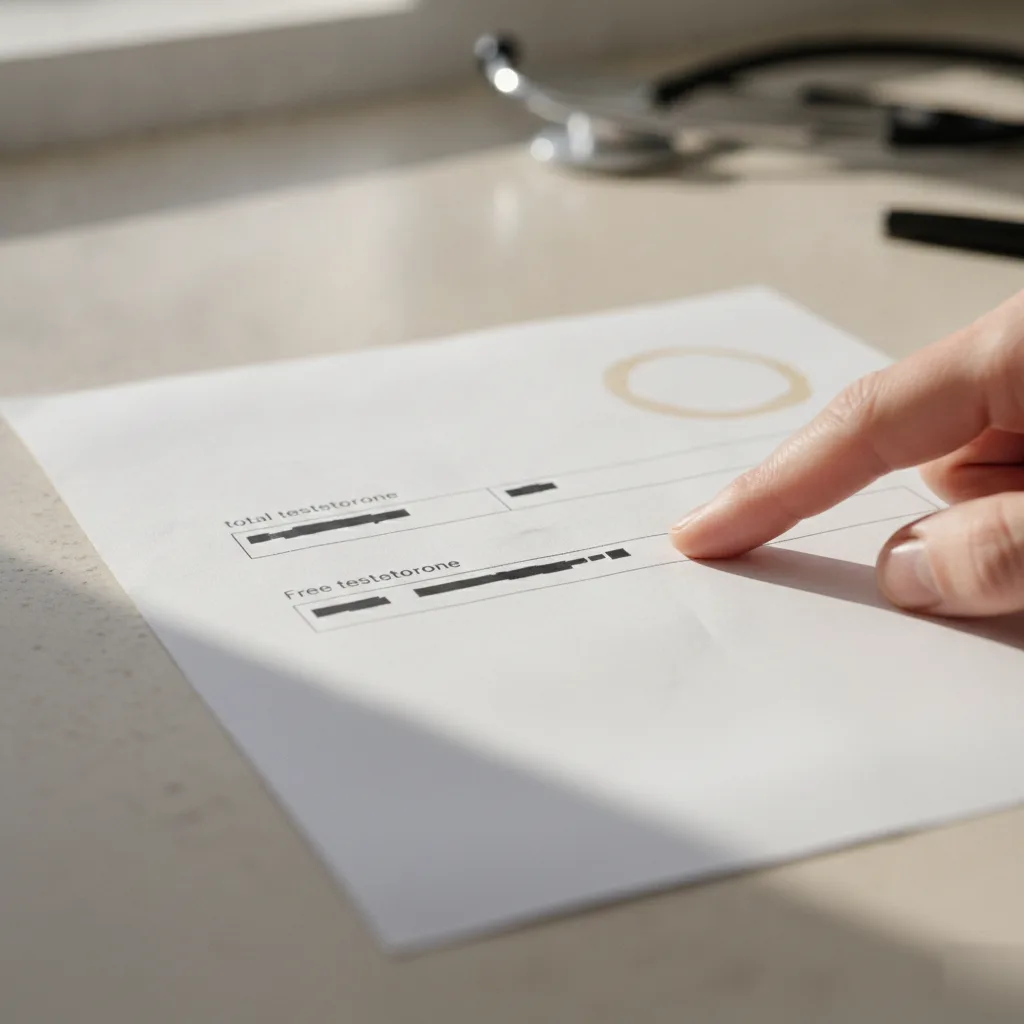
Yes. Testosterone usually peaks in the early morning and drops through the day, so the time of your blood draw changes the number you get.
The American Urological Association guideline on testosterone deficiency recommends measuring total testosterone in the morning and repeating the test on a separate day before confirming a low result. Many practices aim for an early-morning draw. A morning draw gives a physician the closest look at your daily high point.
Timing matters most when your first test was an afternoon draw tucked into a routine physical, because that result may not match your true morning level. The reverse isn't automatic either: a morning result can still be off if other things on test day pulled it off course (see the blood draw factors below).
If you plan to retest, a few preparation steps help the result reflect your usual baseline:
- Book a morning appointment. Ask for an early draw so the result is comparable to guideline-based testing.
- Get a normal night of sleep. A short or broken night before the test can push the number down.
- Ask whether fasting is needed. Some panels include blood sugar or lipids, which may require fasting.
- Avoid testing while sick. A cold, flu, or other acute illness can temporarily lower testosterone, so reschedule if you can.
What Is the Difference Between Total and Free Testosterone?
Total testosterone counts all the testosterone in your blood, while free testosterone is the small portion your body can use right away.
Most of the testosterone in your bloodstream is attached to proteins. The main binding protein is SHBG (sex hormone binding globulin), which holds testosterone tightly so cells can't use it. A smaller share binds loosely to albumin, and only a small fraction circulates unbound as free testosterone. That free fraction, along with the loosely bound share, is what your tissues can actually act on.
SHBG often rises with age. When SHBG climbs, more testosterone gets locked up, and the free fraction can shrink even while the total stays inside the normal range. On paper, your total testosterone can look fine while the usable amount is low.
Many routine checkups only order total testosterone. That's a reasonable first screen, but it can't show how much of the hormone is available. A retest that adds free testosterone and SHBG can change the picture, especially if your symptoms don't match a normal total result.
Why Would My Total Testosterone Be Normal but Free Testosterone Low?
A normal total with low free testosterone usually happens when SHBG is high and ties up more of your testosterone. Factors commonly linked to higher SHBG include aging and certain thyroid and liver conditions.
Because of that link, a physician reads total testosterone, SHBG, and free testosterone together rather than leaning on one value. A normal total next to a high SHBG is a signal to look harder at free testosterone, and also a clue to check thyroid or liver function, since the cause of the high SHBG matters as much as the hormone number itself.
What Can Lower Testosterone on the Day of Your Blood Draw?
Short-term factors like poor sleep, a recent illness, or a heavy meal can push one test result away from your usual level. A single draw reflects that morning, not your average.
Short nights are linked to lower morning testosterone. That link matters in Lake Mary, where the Heathrow corridor and International Parkway are home to many corporate headquarters and professional services employers. Early flights, late client dinners, and irregular hours are common, and any of them can show up in a morning blood draw.
Acute illness can temporarily lower results. Some medicines, such as opioids and steroids, can also reduce testosterone, so your physician needs a full medication list to interpret the number.
Longer-term factors matter too. Extra body weight and insulin resistance are tied to lower testosterone over time. Because weight and hormones affect each other, we look at them together instead of treating one in isolation.
Think back to your first test. That result may not represent your true baseline if any of these applied:
- You slept poorly or far less than usual the night before
- You were sick or running a fever around the test date
- The draw was in the afternoon or evening
- You ate a large meal shortly beforehand
- You were taking a medicine such as an opioid or a steroid
Which Other Hormones and Markers Should Be Checked With Testosterone?
A single testosterone number can't explain fatigue or low drive on its own, so a useful retest also looks at thyroid and metabolic markers.
Thyroid problems can cause tiredness, weight gain, and low energy that look a lot like low testosterone. If the thyroid is the real issue, treating testosterone alone would miss the cause.
Metabolic markers such as blood sugar and lipids matter because insulin resistance and extra weight are linked to lower testosterone. If your blood sugar is rising and your energy is falling, the two problems may be feeding each other.
When testosterone is confirmed low, physicians may also consider markers such as LH (luteinizing hormone), FSH (follicle-stimulating hormone), estradiol, or prolactin. LH and FSH are pituitary signals that tell the testes to make testosterone, so these markers help show where the problem starts.
| Marker | Why it matters for your symptoms |
|---|---|
| Total testosterone | Baseline measure; best read from two early-morning draws |
| Free testosterone | Shows how much testosterone your body can use right away |
| SHBG | Explains why total can look normal while free is low |
| Thyroid markers | Thyroid problems can mimic low testosterone with fatigue and weight gain |
| Blood sugar | Insulin resistance is linked to lower testosterone |
| Lipids | Part of the metabolic picture tied to weight and hormone health |
When Does Retesting Make Sense for Men in Lake Mary?
Retesting makes sense when your symptoms have not gone away, your first test was not done in the morning, or only total testosterone was checked. Any one of those reasons can justify a second look.
Symptoms that point toward retesting include steady fatigue, low sex drive, erection changes, losing muscle, gaining belly fat, and low mood. None of these signs proves low testosterone, and several overlap with thyroid and metabolic problems, which is why a fuller panel helps.
Central Florida heat and humidity limit outdoor exercise from about May through October, with the heat index regularly above 100°F. During those months, “just exercise more” advice often fails in practice, and a weight or energy slump can be blamed on the season when a hormone issue is part of the story.
Many patients in Seminole County arrive having already had primary care labs flagged for pre-diabetes, elevated triglycerides, or hypertension, with no structured next step from their primary care physician. Those metabolic findings overlap with low testosterone, so a flagged lipid or blood sugar result is a good reason to look at hormones too.
Retest if any of these are true:
- Your symptoms are the same or worse since your “normal” result
- Your first blood draw was in the afternoon or evening
- Only total testosterone was measured, without free testosterone or SHBG
- Your result was near the bottom of the reference range
- Your labs showed pre-diabetes, high triglycerides, or other metabolic flags
How a Physician-Reviewed Hormone Panel Works at Svelte
At Svelte Medical Weight Loss Centers Lake Mary, the first visit includes a comprehensive blood panel and a consultation with the physician, not a sales pitch.
Our men's hormone panel covers testosterone, thyroid, and metabolic markers. The physician reviews the results personally, rather than relying on what a lab flags as high or low. That review is where questions about draw timing, SHBG, and borderline values get answered.
Board-certified family physician Dr. Richard Bragg personally oversees care at Svelte. Treatment isn't handed off to coaches or non-physician staff. Dr. Bragg has been board certified by the American Board of Family Physicians since 1995.
Testosterone replacement therapy (TRT) is only considered after a lab-confirmed low testosterone diagnosis. Each plan is built from your labs, symptoms, and goals before anything is prescribed. If your labs point to thyroid or metabolic causes instead, those findings shape the plan, which can include our physician-supervised weight loss programs grounded in insulin science.
A few details about our practice:
- Svelte has been in operation in Central Florida since 2008.
- Dr. Bragg served as Seminole County Medical Society President in 2008.
- Svelte is a Certified Platinum Level Biote Provider for bioidentical hormone pellet therapy.
- Svelte holds a 4.9-star average across 131 Google reviews.
A retest at Svelte doesn't promise a particular result. Its purpose is a clearer answer, whether that answer points toward treatment or away from it.
The Bottom Line on Retesting a Normal Testosterone Result
A normal testosterone result is one snapshot. Draw timing, wide lab ranges, and total-only testing can each hide a real problem. Two early-morning tests, plus free testosterone, SHBG, and thyroid and metabolic markers, give a clearer answer than one routine draw.
If your symptoms are still here, a second and more complete test is a reasonable next step. If you live in Lake Mary, Heathrow, or nearby Seminole County, you can book a physician-reviewed hormone panel at Svelte Medical Weight Loss Centers Lake Mary and have your results interpreted in the context of how you actually feel.
Book Your Consultation
Ready for a Svelte transformation?
Take the first step toward better health and metabolic stability today.
Our team is here to support you.